 Add to Chrome
 Add to Firefox
 Add to Edge
Large Language Model-Powered Query-Driven Event Timeline Summarization in Industrial Search
May 26, 2026
Understanding how events evolve over time is essential for search engines handling queries about trending news. We present QDET (Query-Driven Event Timeline Summarization), a production system deployed on Baidu Search that constructs focused event timelines to explain specific query events. Unlike traditional topic-centric approaches that aim for comprehensive coverage, QDET identifies and organizes sub-events closely relevant to the query from noisy candidate sets formed by millions of documents retrieved daily. QDET incorporates two key innovations: (1) multi-task supervised fine-tuning with three auxiliary tasks-temporal ordering, causal judgment, and timeline completion-that enable compact models to match the performance of much larger general-purpose models in specialized domains; (2) reinforcement learning-based event concise summarization that enforces strict length constraints while maintaining semantic quality, achieving 88.2% length compliance and outperforming 671B-scale models by 7.7 points in constraint satisfaction. Our fine-tuned 7B parameter model achieves 76.2% F1 score on timeline summarization, slightly surpassing the zero-shot performance of DeepSeek-R1-671B (76.1% F1) while using only 1% of its parameters-demonstrating that domain-specific optimization enables production-ready models with comparable quality at drastically reduced computational costs. Online A/B tests on Baidu Search validate real-world effectiveness, showing 5.5% CTR improvement, 4.6% longer dwell time, and 4.4% deeper exploration compared to single-task baselines. We further demonstrate that timeline understanding transfers to heat prediction, confirming effective knowledge transfer to downstream tasks.

RAG-Enhanced Large Language Models for Dynamic Content Expiration Prediction in Web Search
May 13, 2026In commercial web search, aligning content freshness with user intent remains challenging due to the highly varied lifespans of information. Traditional industrial approaches rely on static time-window filtering, resulting in "one-size-fits-all" rankings where content may be chronologically recent but semantically expired. To address the limitation, we present a novel Large Language Models (LLMs)-based Query-Aware Dynamic Content Expiration Prediction Framework deployed in Baidu search, reformulating timeliness as a dynamic validity inference task. Our framework extracts fine-grained temporal contexts from documents and leverages LLMs to deduce a query-specific "validity horizon"-a semantic boundary defining when information becomes obsolete based on user intent. Integrated with robust hallucination mitigation strategies to ensure reliability, our approach has been evaluated through offline and online A/B testing on live production traffic. Results demonstrate significant improvements in search freshness and user experience metrics, validating the effectiveness of LLM-driven reasoning for solving semantic expiration at an industrial scale.
SemaClaw: A Step Towards General-Purpose Personal AI Agents through Harness Engineering
Apr 13, 2026The rise of OpenClaw in early 2026 marks the moment when millions of users began deploying personal AI agents into their daily lives, delegating tasks ranging from travel planning to multi-step research. This scale of adoption signals that two parallel arcs of development have reached an inflection point. First is a paradigm shift in AI engineering, evolving from prompt and context engineering to harness engineering-designing the complete infrastructure necessary to transform unconstrained agents into controllable, auditable, and production-reliable systems. As model capabilities converge, this harness layer is becoming the primary site of architectural differentiation. Second is the evolution of human-agent interaction from discrete tasks toward a persistent, contextually aware collaborative relationship, which demands open, trustworthy and extensible harness infrastructure. We present SemaClaw, an open-source multi-agent application framework that addresses these shifts by taking a step towards general-purpose personal AI agents through harness engineering. Our primary contributions include a DAG-based two-phase hybrid agent team orchestration method, a PermissionBridge behavioral safety system, a three-tier context management architecture, and an agentic wiki skill for automated personal knowledge base construction.
AMAP Agentic Planning Technical Report
Dec 31, 2025We present STAgent, an agentic large language model tailored for spatio-temporal understanding, designed to solve complex tasks such as constrained point-of-interest discovery and itinerary planning. STAgent is a specialized model capable of interacting with ten distinct tools within spatio-temporal scenarios, enabling it to explore, verify, and refine intermediate steps during complex reasoning. Notably, STAgent effectively preserves its general capabilities. We empower STAgent with these capabilities through three key contributions: (1) a stable tool environment that supports over ten domain-specific tools, enabling asynchronous rollout and training; (2) a hierarchical data curation framework that identifies high-quality data like a needle in a haystack, curating high-quality queries with a filter ratio of 1:10,000, emphasizing both diversity and difficulty; and (3) a cascaded training recipe that starts with a seed SFT stage acting as a guardian to measure query difficulty, followed by a second SFT stage fine-tuned on queries with high certainty, and an ultimate RL stage that leverages data of low certainty. Initialized with Qwen3-30B-A3B to establish a strong SFT foundation and leverage insights into sample difficulty, STAgent yields promising performance on TravelBench while maintaining its general capabilities across a wide range of general benchmarks, thereby demonstrating the effectiveness of our proposed agentic model.
Deep Tensor Learning for Reliable Channel Charting from Incomplete and Noisy Measurements
Sep 16, 2025Channel charting has emerged as a powerful tool for user equipment localization and wireless environment sensing. Its efficacy lies in mapping high-dimensional channel data into low-dimensional features that preserve the relative similarities of the original data. However, existing channel charting methods are largely developed using simulated or indoor measurements, often assuming clean and complete channel data across all frequency bands. In contrast, real-world channels collected from base stations are typically incomplete due to frequency hopping and are significantly noisy, particularly at cell edges. These challenging conditions greatly degrade the performance of current methods. To address this, we propose a deep tensor learning method that leverages the inherent tensor structure of wireless channels to effectively extract informative while low-dimensional features (i.e., channel charts) from noisy and incomplete measurements. Experimental results demonstrate the reliability and effectiveness of the proposed approach in these challenging scenarios.
Towards Reward Fairness in RLHF: From a Resource Allocation Perspective
May 29, 2025Rewards serve as proxies for human preferences and play a crucial role in Reinforcement Learning from Human Feedback (RLHF). However, if these rewards are inherently imperfect, exhibiting various biases, they can adversely affect the alignment of large language models (LLMs). In this paper, we collectively define the various biases present in rewards as the problem of reward unfairness. We propose a bias-agnostic method to address the issue of reward fairness from a resource allocation perspective, without specifically designing for each type of bias, yet effectively mitigating them. Specifically, we model preference learning as a resource allocation problem, treating rewards as resources to be allocated while considering the trade-off between utility and fairness in their distribution. We propose two methods, Fairness Regularization and Fairness Coefficient, to achieve fairness in rewards. We apply our methods in both verification and reinforcement learning scenarios to obtain a fairness reward model and a policy model, respectively. Experiments conducted in these scenarios demonstrate that our approach aligns LLMs with human preferences in a more fair manner.
GUNDAM: Aligning Large Language Models with Graph Understanding
Sep 30, 2024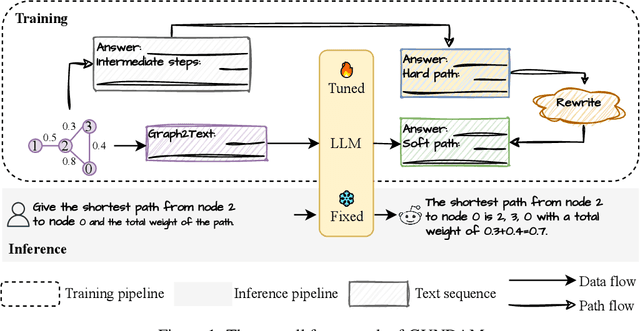

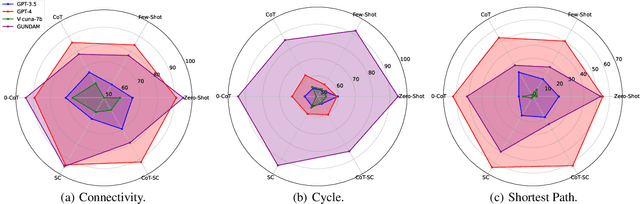

Large Language Models (LLMs) have achieved impressive results in processing text data, which has sparked interest in applying these models beyond textual data, such as graphs. In the field of graph learning, there is a growing interest in harnessing LLMs to comprehend and manipulate graph-structured data. Existing research predominantly focuses on graphs with rich textual features, such as knowledge graphs or text attribute graphs, leveraging LLMs' ability to process text but inadequately addressing graph structure. This work specifically aims to assess and enhance LLMs' abilities to comprehend and utilize the structural knowledge inherent in graph data itself, rather than focusing solely on graphs rich in textual content. To achieve this, we introduce the \textbf{G}raph \textbf{U}nderstanding for \textbf{N}atural Language \textbf{D}riven \textbf{A}nalytical \textbf{M}odel (\model). This model adapts LLMs to better understand and engage with the structure of graph data, enabling them to perform complex reasoning tasks by leveraging the graph's structure itself. Our experimental evaluations on graph reasoning benchmarks not only substantiate that \model~ outperforms the SOTA baselines for comparisons. But also reveals key factors affecting the graph reasoning capabilities of LLMs. Moreover, we provide a theoretical analysis illustrating how reasoning paths can enhance LLMs' reasoning capabilities.
Preserving Node Distinctness in Graph Autoencoders via Similarity Distillation
Jun 25, 2024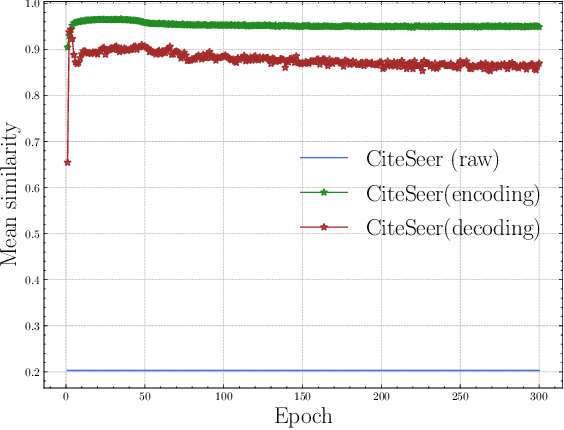
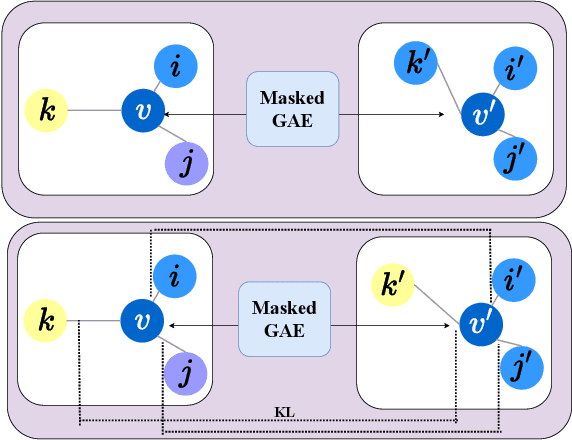
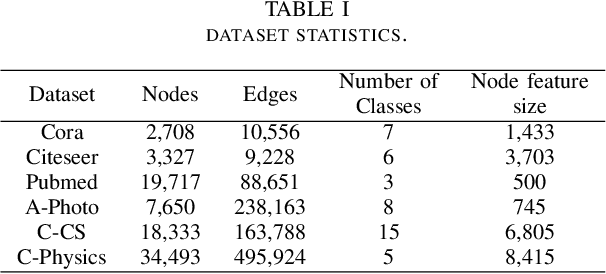
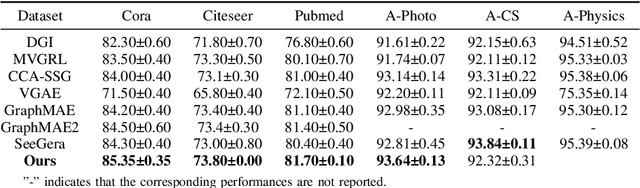
Graph autoencoders (GAEs), as a kind of generative self-supervised learning approach, have shown great potential in recent years. GAEs typically rely on distance-based criteria, such as mean-square-error (MSE), to reconstruct the input graph. However, relying solely on a single reconstruction criterion may lead to a loss of distinctiveness in the reconstructed graph, causing nodes to collapse into similar representations and resulting in sub-optimal performance. To address this issue, we have developed a simple yet effective strategy to preserve the necessary distinctness in the reconstructed graph. Inspired by the knowledge distillation technique, we found that the dual encoder-decoder architecture of GAEs can be viewed as a teacher-student relationship. Therefore, we propose transferring the knowledge of distinctness from the raw graph to the reconstructed graph, achieved through a simple KL constraint. Specifically, we compute pairwise node similarity scores in the raw graph and reconstructed graph. During the training process, the KL constraint is optimized alongside the reconstruction criterion. We conducted extensive experiments across three types of graph tasks, demonstrating the effectiveness and generality of our strategy. This indicates that the proposed approach can be employed as a plug-and-play method to avoid vague reconstructions and enhance overall performance.
Towards Comprehensive Preference Data Collection for Reward Modeling
Jun 24, 2024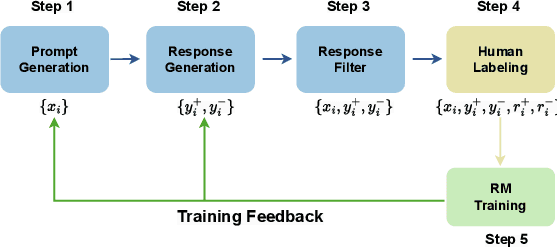
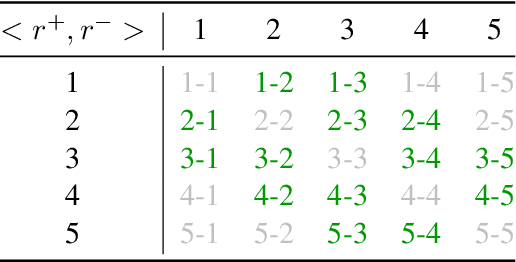
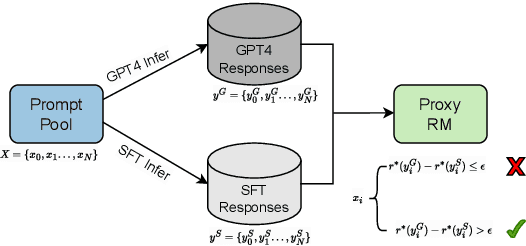
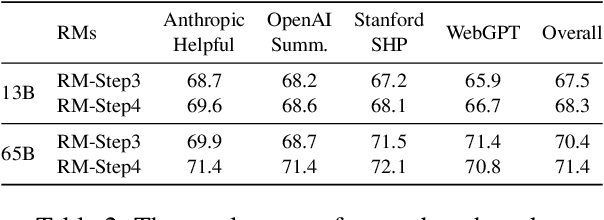
Reinforcement Learning from Human Feedback (RLHF) facilitates the alignment of large language models (LLMs) with human preferences, thereby enhancing the quality of responses generated. A critical component of RLHF is the reward model, which is trained on preference data and outputs a scalar reward during the inference stage. However, the collection of preference data still lacks thorough investigation. Recent studies indicate that preference data is collected either by AI or humans, where chosen and rejected instances are identified among pairwise responses. We question whether this process effectively filters out noise and ensures sufficient diversity in collected data. To address these concerns, for the first time, we propose a comprehensive framework for preference data collection, decomposing the process into four incremental steps: Prompt Generation, Response Generation, Response Filtering, and Human Labeling. This structured approach ensures the collection of high-quality preferences while reducing reliance on human labor. We conducted comprehensive experiments based on the data collected at different stages, demonstrating the effectiveness of the proposed data collection method.
Exploring Task Unification in Graph Representation Learning via Generative Approach
Mar 21, 2024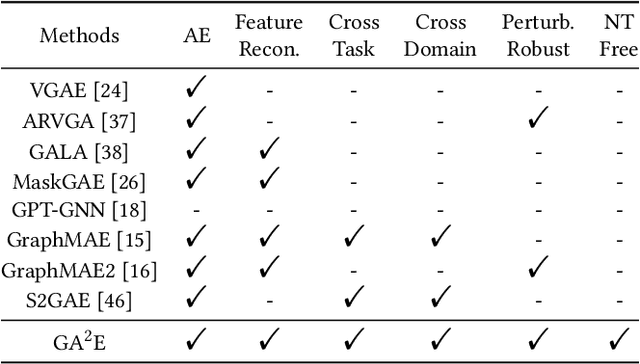
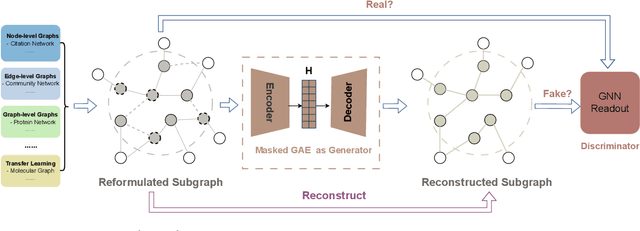
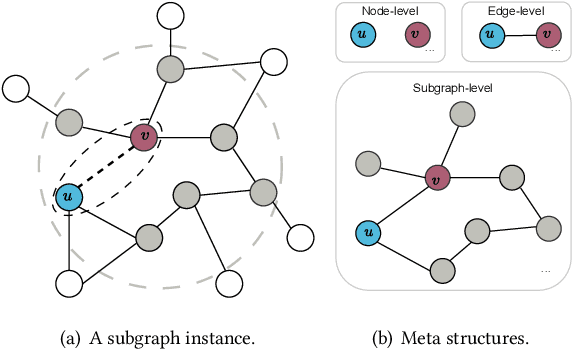
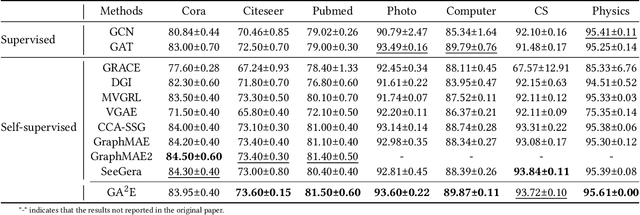
Graphs are ubiquitous in real-world scenarios and encompass a diverse range of tasks, from node-, edge-, and graph-level tasks to transfer learning. However, designing specific tasks for each type of graph data is often costly and lacks generalizability. Recent endeavors under the "Pre-training + Fine-tuning" or "Pre-training + Prompt" paradigms aim to design a unified framework capable of generalizing across multiple graph tasks. Among these, graph autoencoders (GAEs), generative self-supervised models, have demonstrated their potential in effectively addressing various graph tasks. Nevertheless, these methods typically employ multi-stage training and require adaptive designs, which on one hand make it difficult to be seamlessly applied to diverse graph tasks and on the other hand overlook the negative impact caused by discrepancies in task objectives between the different stages. To address these challenges, we propose GA^2E, a unified adversarially masked autoencoder capable of addressing the above challenges seamlessly. Specifically, GA^2E proposes to use the subgraph as the meta-structure, which remains consistent across all graph tasks (ranging from node-, edge-, and graph-level to transfer learning) and all stages (both during training and inference). Further, GA^2E operates in a \textbf{"Generate then Discriminate"} manner. It leverages the masked GAE to reconstruct the input subgraph whilst treating it as a generator to compel the reconstructed graphs resemble the input subgraph. Furthermore, GA^2E introduces an auxiliary discriminator to discern the authenticity between the reconstructed (generated) subgraph and the input subgraph, thus ensuring the robustness of the graph representation through adversarial training mechanisms. We validate GA^2E's capabilities through extensive experiments on 21 datasets across four types of graph tasks.